




A versatile electronic component integrating precise rotational adjustment and push-button control, the smooth Rotary Encoder with Push Button Switch delivers reliable performance and intuitive operation, making it a staple across diverse electronic devices. Below is a detailed overview of its universal structure, core specifications, working principles, and multi-industry applications:
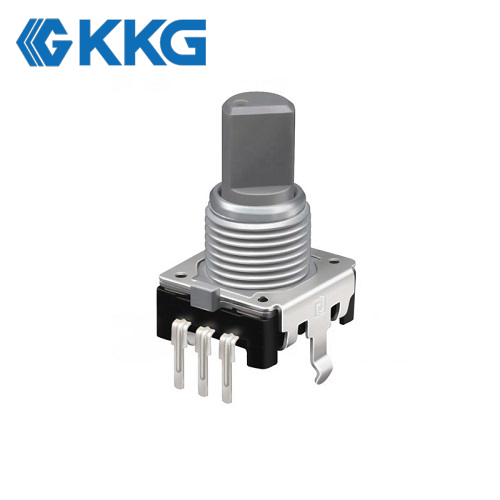
Universal Structure & Design
Main Body & Operation Components: Featuring a compact, low-profile package, this encoder is designed for seamless integration into various circuit boards. Its core includes a knurled metal shaft—with adjustable length and diameter to fit different devices—whose knurling enhances grip friction, preventing slippage during operation. Internally, a combination of mechanical contacts, annular conductive tracks, and metal springs ensures smooth rotation while providing clear detent feedback, allowing users to perceive adjustment rhythms intuitively.
Pin Configuration & Button Encapsulation: Available in through-hole and surface-mount (SMD) packages. Through-hole models typically adopt a 5-pin design: 3 pins on one side handle grounding and dual-channel encoder signal transmission, while the other 2 pins control the built-in push button. SMD variants feature additional mechanical pads to strengthen circuit board adhesion, minimizing detachment risks caused by vibration or external forces. The push button is integrated into the shaft center, offering a 1–2mm travel with smooth pressing and rebound, free from jitter or sticking.
Core Performance Specifications
Rotation precision ranges from 12 to 30 detents per revolution, with different detent options catering to varying accuracy requirements. Detents are clearly defined with tactile feedback, and resolution can be further enhanced via microcontroller-based frequency multiplication. Service life typically spans 20,000–100,000 rotations and 20,000–100,000 presses, with high-end models exceeding 100,000 cycles—suitable for high-frequency consumer electronics and long-term industrial use. Electrically, it operates at a rated voltage of 5V DC and rated current of 10–15mA, boasting ultra-low contact resistance (as low as 50mΩ) to minimize signal loss. Insulation resistance is no less than 100MΩ, with a voltage resistance of 250–300V AC, ensuring stable electrical performance. Environmentally, it functions reliably within a temperature range of -40℃ to 85℃, adapting to extreme conditions in automotive and outdoor applications. The shaft offers high push-pull strength, tight axial play control, and robust mechanical durability.
Working Principles
Rotary Encoding Mechanism: When the knob rotates, internal metal springs slide along annular conductive tracks, alternately opening and closing circuits to output two-phase (A/B) orthogonal square wave signals with a 90° phase shift. A microcontroller uses quadrature decoding to determine rotation direction: if Phase B is low when Phase A rises, it is clockwise rotation; if Phase B is high, it is counterclockwise. The number of pulses is counted to convert rotational displacement into digital signals, enabling precise parameter adjustment.
Push Button Control Mechanism: A normally open push button is integrated into the shaft center. Pressing the knob closes the SWITCH, outputting a trigger signal via an independent pin. This function can be flexibly configured for confirmation, start/stop, mode switching, or other operations, forming a dual-mode "adjust + confirm" logic that simplifies device operation. With internal pull-up resistors or code-based settings, push events are easily detected, and simple delay debouncing prevents false triggers caused by mechanical jitter.
Multi-Industry Applications
Consumer Electronics: Ideal for audio equipment (speakers, headphone amplifiers, mixers) to adjust volume, equalizers, or reverberation—its precise detents prevent sudden volume jumps, enabling blind operation for audio professionals. In smart speakers, smart home control panels, and portable voice recorders, it adjusts lighting brightness, HVAC temperature, or audio timelines, with pushes for confirmation or key point marking. It is also widely used in mouse scroll wheels for smooth navigation.
Industrial & Medical Equipment: In industrial control panels, it regulates device frequency, speed, or process parameters, with temperature resistance and anti-interference capabilities suited for harsh industrial environments. For test instruments (e.g., oscilloscopes), it facilitates menu navigation and parameter fine-tuning. In medical devices, it calibrates instrument settings and adjusts display data, ensuring reliable operation through precise and stable performance.
Embedded & DIY Electronics: A popular component for open-source hardware projects (e.g., Arduino, Raspberry Pi) and embedded control systems, it enables text scrolling, menu navigation, and selection confirmation with minimal code. Compatible with resource-constrained systems, it reduces interaction design costs for embedded devices. It also enhances smart conference terminals, supporting meeting minutes browsing (rotation) and key point marking/export (push/long press).
This encoder combines versatility, durability, and user-friendliness, making it an essential component for product design across consumer, industrial, and professional sectors.