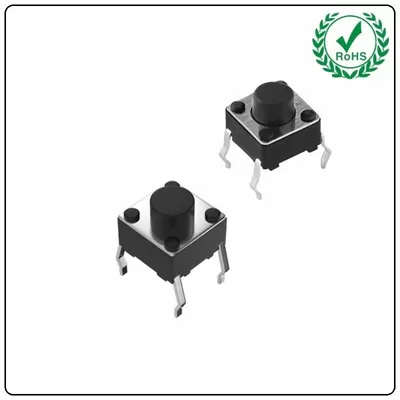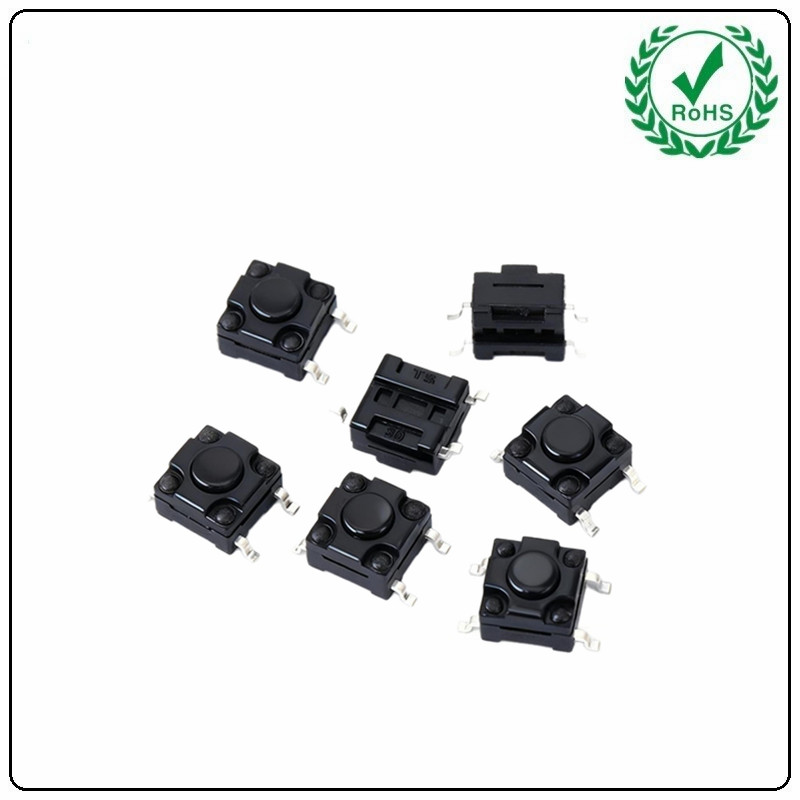


The 6×6 tact switch is an electronic component that completes a circuit through light pressure, representing a common specification within the tact switch category. The “6×6” in its name denotes the switch's external dimensions: 6 millimeters in length and 6 millimeters in width.
Structural Components
Button Cap: The part directly pressed by the user, typically designed as round or square, with customizable colors or logos on the surface.
Spring Contact (Contact Blade): The core component, made of phosphor bronze, stainless steel, or other metallic materials, providing both elasticity and conductivity. When pressed, the blade deforms
to make contact; upon release, it returns to its original shape, breaking the circuit.
Pins: Used for soldering to circuit boards to establish electrical connections. Common pin types include through-hole (straight or angled) and surface-mount (SMD).
Housing: Protects internal components, typically made of plastic or metal. Some models feature waterproof and dustproof capabilities.
Operating Principle
Normal State (Open Circuit)
Without external force, the spring leaf remains in its natural state. The contacts are separated from the circuit connection points, preventing current flow and maintaining an open circuit.
Pressing Action (Closed State)
Pressing the button cap transfers pressure to the spring leaf, causing elastic deformation. The contacts engage with the connection points, allowing current flow and closing the circuit. Example: Pressing
a remote control button activates the signal transmission path between the battery and control chip.
Release and Reset (Return to Open State)
After releasing the button cap, the spring plate returns to its original shape via its inherent elasticity, separating the contacts from the connection point and breaking the circuit. For example: When releasing
a mouse button, the click command transmission ends.
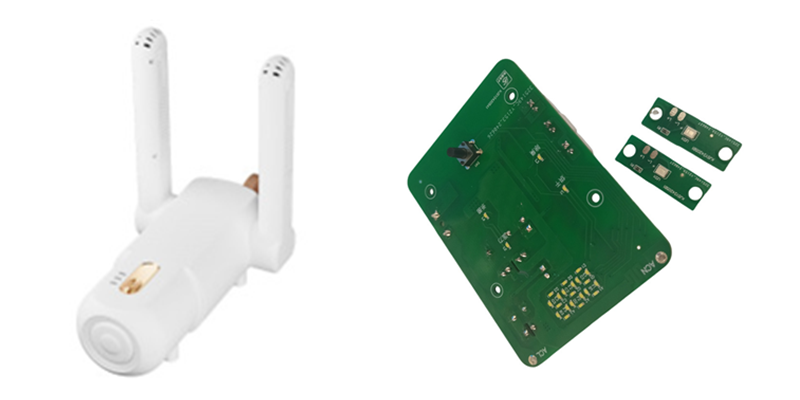
Tactile Switches are widely used in shoe dryers due to their compact size, ease of operation, and long service life. They primarily enable functions such as power control, mode switching, and timer settings.
Typical Applications of tactile switches in Shoe Dryers
Power Switch
Function: Controls power on/off for the shoe dryer, representing the most frequently operated component.
Design: Typically employs 6×6mm or 8×8mm tactile switches mounted on the dryer's exterior surface. Users activate power by pressing the switch.
Advantages: Compared to traditional mechanical switches, tactile switches are more compact, saving internal space. They also offer a softer, more responsive operation, enhancing user experience.
Mode Switching
Function: Switches between different operating modes (e.g., low-temperature drying, high-temperature sterilization, timed drying).
Design: Multiple tactile switches or combination buttons enable mode selection. Some models support distinguishing functions via long press/short press.
Advantages: The rapid response of touch switches suits mode switching scenarios. Customizable actuation force (e.g., 60g or 180g) prevents accidental operation.
Timer Setting
Function: Sets the shoe dryer's operating duration (e.g., 30 minutes, 60 minutes, 90 minutes).
Design: Utilizes touch switches paired with digital displays or indicator lights. Users adjust time parameters via button presses.
Advantages: The long lifespan of touch switches (up to 100,000+ cycles) suits scenarios requiring frequent timer adjustments.
Temperature Adjustment
Function: Adjusts the shoe dryer's heating temperature (e.g., low-heat mode, high-heat mode).
Design: Temperature mode switching via touch switches; some models support stepless temperature adjustment (requires circuit design).
Advantages: Precise contact control of touch switches ensures stable temperature regulation, preventing fluctuations.