




A Dip Switch(Dual In-line Package SWITCH)is a small manual electronic component used to configure hardware settings on devices and circuit boards.It is made up of a row of tiny switches that can be toggled between ON and OFF positions.Although simple in structure,a Dip Switch plays an important role in controlling how electronic devices operate without needing software or digital programming.
The term dip switch comes from its packaging style,which resembles a Dual In-line Package(DIP)integrated circuit.This compact design allows it to be mounted directly onto printed circuit boards(PCBs),making it widely used in industrial equipment,consumer electronics,and embedded systems.
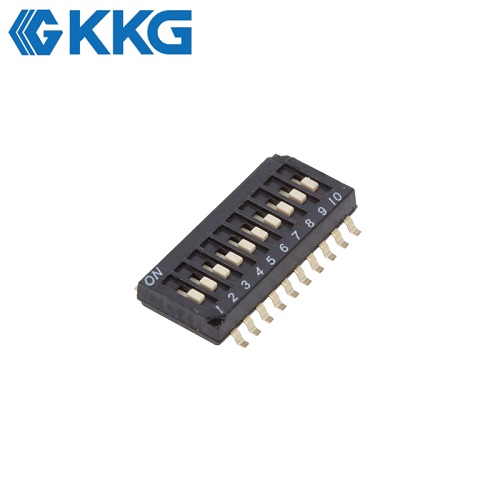
Basic Structure and Working Principle of DIP Switch
A typical dip switch consists of several individual switches arranged in a straight line.Each switch represents a binary state:
ON=1(active,connected circuit)
OFF=0(inactive,open circuit)
When a switch is turned ON,it completes an electrical connection.When it is turned OFF,the connection is broken.By combining multiple switches,a device can represent different binary codes,allowing hardware configuration without software input.
For example,an 8-position dip switch can create 256 possible combinations(2⁸).Each combination corresponds to a specific device setting defined by the manufacturer.
This is why dip switches are widely used in systems that require fixed configurations,such as industrial machines,communication modules,and control systems.
Common Applications of DIP Switch
A dip switch is used in many electronic devices because it allows users to manually adjust settings.Some common applications include:
Setting device addresses in industrial automation systems
Configuring communication protocols(RS-232,RS-485,etc.)
Selecting operating modes in embedded controllers
Enabling or disabling hardware features
Adjusting compatibility settings in electronic devices
One widely known application is the dip switch garage door opener.In older garage door systems,dip switches are used to set a unique code between the remote control and the receiver unit.By matching the switch pattern on both devices,the system ensures that only the correct remote can open the garage door.This helps prevent interference from other remotes operating nearby.
Although modern garage door openers often use rolling codes and digital encryption,dip switch-based systems are still found in many residential and commercial installations.
What Are DIP Switch Settings?
Dip switch settings refer to the specific ON/OFF configuration of each switch in a dip switch array.These settings determine how a device behaves.
Manufacturers provide detailed instructions showing how to set the switches correctly.Even a small change in position can result in a completely different function.
For example:
Switch 1–4 may define device ID
Switch 5 may select communication speed
Switch 6–8 may enable special features
Incorrect dip switch settings can cause communication errors,device malfunction,or system conflicts,so proper configuration is essential.
Because of this,most products include a user manual with a clear configuration guide or reference table.
DIP Switch Chart Explained
A dip switch chart is a table that shows how different switch positions correspond to specific device functions.It is one of the most important tools for users when configuring hardware.
A simple dip switch chart may look like this:
| Function Mode | Switch 1 | Switch 2 | Switch 3 | Switch 4 |
| Mode A | ON | OFF | ON | OFF |
| Mode B | OFF | ON | ON | OFF |
| Mode C | ON | ON | OFF | OFF |
| Mode D | OFF | OFF | OFF | ON |
By following the chart,users can quickly adjust settings without needing technical knowledge of electronics.
Dip switch charts are especially useful in industrial environments where multiple machines must be configured consistently and quickly.
DIP Switch Diagram and Visual Understanding
A dip switch diagram is a visual representation of how switches are arranged and how each position corresponds to a function.It is often printed directly on the device casing,circuit board,or instruction manual.
A typical dip switch diagram includes:
Numbered switches(1,2,3,4,etc.)
ON and OFF direction indicators
Function mapping labels
Binary value references
For beginners,a dip switch diagram is extremely helpful because it visually explains how to set each switch correctly.Instead of interpreting technical descriptions,users can simply match the physical switch positions to the diagram.
In some advanced systems,the diagram may also show binary code interpretations or configuration examples for faster setup.
Types of DIP Switch
There are several types of dip switches designed for different applications:
1.Slide DIP Switch
This is the most common type.Each switch slides left or right(or up and down)to change its position.It is widely used in PCB-mounted devices.
2.Piano DIP Switch
This type looks like a row of small buttons.Each switch is pressed down like a piano key to toggle ON or OFF.It is easy to operate and provides a clear visual indication.
3.Rotary Dip Switch
Instead of individual switches,this type uses a rotating dial to select numbers or codes.It is often used when multiple combinations are needed in a compact space.
Each type serves the same basic function but is chosen based on design requirements,space limitations,and ease of use.
Advantages of DIP Switch
Even with modern digital configuration methods,dip switches remain widely used because they offer several advantages:
No software required–settings are hardware-based
Easy configuration–simple ON/OFF operation
Reliable performance–no risk of software failure
Power-independent memory–settings remain even when power is off
Low cost–inexpensive component for manufacturers
These advantages make dip switches especially suitable for industrial systems,embedded electronics,and legacy equipment.
Limitations of DIP Switch
Despite their benefits,dip switches also have limitations:
Limited number of configuration options
Not suitable for frequently changing settings
Requires manual adjustment
Risk of incorrect setup if instructions are not followed
Because of these limitations,dip switches are often replaced by software-based configuration in modern smart devices.
DIP Switch in Modern Applications
Although technology has advanced,the dip switch is still widely used in many fields.It remains popular in:
Industrial control systems
Networking equipment
Robotics and automation
Security systems
Legacy consumer electronics
Even devices like a dip switch garage door opener show how this simple technology continues to be practical in real-world applications.
FAQ
Q1:What is a DIP switch on a garage door opener?
A DIP switch on a garage door opener is a set of small manual switches used to set a matching code between the remote control and the garage door receiver.When both devices have the same ON/OFF combination,the remote can operate the door.
Q2:Are DIP switches still used?
Yes,DIP switches are still used,especially in older garage door openers,industrial equipment,and embedded systems.However,many modern devices have replaced them with digital coding systems like rolling code technology.
Q3:Why are DIP switches called DIP switches?
They are called DIP switches because they are built in a“Dual In-line Package”(DIP),which is a standard electronic housing style with two parallel rows of pins used for mounting on circuit boards.