




A Dip Switch(Dual In-line Package SWITCH)is a small but extremely practical hardware component widely used in electronic devices and industrial control systems.Although it looks simple,this tiny switch block plays an important role in configuring device behavior,setting addresses,and enabling or disabling functions without software.
In this article,we will explain in detail how a Dip Switch works,what it is used for,and why it is still important in certain applications today.
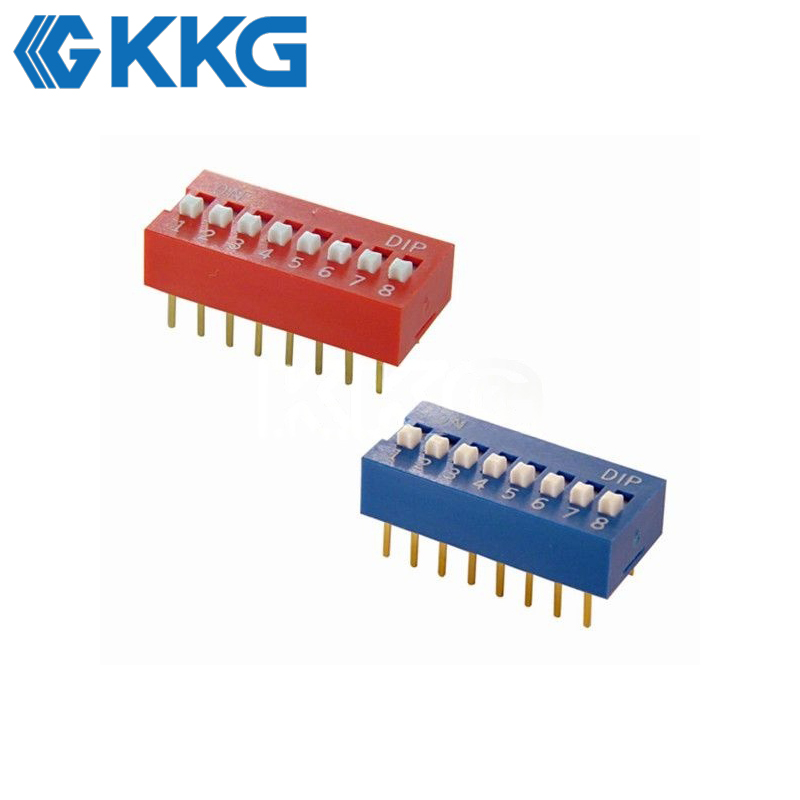
What is a Dip Switch?
Before understanding how it works,we need to answer the question:what is a dip switch?
A DIP switch is a group of small manual switches arranged in a single row or block.The name“DIP”stands for Dual In-line Package,which refers to the standard electronic packaging style where two parallel rows of pins connect the component to a circuit board.
Each tiny switch inside the DIP switch unit can be independently set to:
ON position
OFF position
These ON/OFF positions represent binary values:
ON=1
OFF=0
This means a DIP switch works like a physical binary input system that allows devices to“read”configuration settings manually.
How Does a DIP Switch Work?
A dip switch works by controlling whether electrical current can pass through a circuit or not.
Inside each switch:
When the switch is flipped to ON,metal contacts inside touch each other,closing the circuit.Electricity can flow.
When the switch is flipped to OFF,the contacts separate,opening the circuit.Electricity stops.
Each switch sends a simple electrical signal(1 or 0)to the device’s control board.The device reads the combination of all switches as a binary code.
Example of working principle:
A 4-switch DIP configuration:
ON–OFF–ON–OFF
Binary result:1 0 1 0
The device’s microcontroller interprets this pattern and matches it to a preset function stored in its firmware.This could represent:
device ID
operating mode
communication settings
feature activation
This simple mechanism allows hardware-level configuration without needing software or internet access.
Why DIP Switches Use Binary System
DIP switches are based on the binary system because electronics naturally understand two states:
High/Low voltage
ON/OFF signal
True/False condition
With just a few switches,DIP switches can create many combinations:
2 switches→4 combinations
4 switches→16 combinations
8 switches→256 combinations
This makes them extremely useful for assigning unique device settings in a simple and reliable way.
Applications of DIP Switches
DIP switches are used in many different electronic and industrial fields.While modern systems often use software configuration,DIP switches are still common in devices that require stable and permanent settings.
1.Industrial Equipment
Machines and controllers use DIP switches to set:
machine ID numbers
communication protocols
operating modes
Because settings are hardware-based,they do not change accidentally.
2.Communication Devices
In older networking systems,DIP switches were used to configure:
device addresses
baud rates
transmission modes
This allowed multiple devices to communicate properly on the same system.
3.DIP Switch Garage Door Opener
One of the most familiar real-life uses is the dip switch garage door opener system.
In this setup:
The garage door receiver has a DIP switch pattern
The remote control also has a matching DIP switch pattern
Only when both patterns are identical will the system respond.
This ensures that only authorized remotes can open the garage door.
However,this system is now considered less secure because:
codes can be copied easily
limited number of combinations exist
no encryption is used
4.DIP Switch Garage Door Remote
A dip switch garage door remote contains a small internal switch block.Users must manually match the switch positions to the receiver unit.
For example:
Receiver:ON OFF ON ON OFF
Remote:ON OFF ON ON OFF
When both configurations match,the remote sends the correct signal to trigger the motor.
Although simple,this system was widely used for decades due to its reliability and low cost.
5.Consumer Electronics
Some older devices like:
audio equipment
lighting systems
test instruments
use DIP switches for mode selection or calibration settings.
Advantages of DIP Switches
Even though modern digital systems are more advanced,DIP switches still offer several advantages:
1.Simple Operation
No programming or software is needed.Just flip switches.
2.High Reliability
Once set,the configuration remains stable and does not change easily.
3.Low Cost
DIP switches are inexpensive to manufacture and integrate.
4.No Power Dependency
Settings remain even when power is turned off.
5.Easy Troubleshooting
Technicians can quickly check settings visually.
Limitations of DIP Switches
Despite their benefits,DIP switches also have limitations:
1.Limited Combinations
Even with 8 switches,the number of configurations is still limited.
2.Manual Setup Required
Users must physically open devices and adjust switches.
3.Not Secure
Especially in systems like garage doors,codes can be copied easily.
4.Not User-Friendly for Modern Devices
Software configuration is faster and more flexible.
Because of these limitations,DIP switches are gradually being replaced by digital systems,microcontrollers,and wireless configuration tools.
DIP Switch vs Modern Digital Configuration
Today,many devices have replaced DIP switches with:
mobile apps
software dashboards
cloud-based settings
encrypted wireless pairing
However,DIP switches still remain useful in:
harsh environments
industrial systems
low-cost electronics
backup configuration systems
Their simplicity is still valuable where reliability matters more than flexibility.
FAQ
Q1:What is the difference between SIP and DIP switches?
DIP switch:Two rows of pins,more common and stable on PCBs
SIP switch:One row of pins,smaller and used in tight spaces
Q2:What are the functions of DIP switches?
DIP switches are used to manually set device configurations,such as:
Device ID/address
Operating modes
Feature on/off settings
Remote pairing(e.g.,garage systems)
Q3:What are the three main types of switches?
Mechanical switches(e.g.,DIP,push buttons)
Electronic switches(transistors/semiconductors)
Relay switches(electromagnetic control)
Q4:Does a DIP switch need a resistor?
Yes.Usually a pull-up or pull-down resistor is needed to ensure a stable signal when the switch is OFF.